You are the FIFA president at ten past three in the morning with a stadium roof failing. The chairman of your club the night the owner sells. The FA president whose squad will not board the plane. Type anything — a phone call, a sacking, a sulk — and the narrator writes the world's answer.
Open a story →
FIFA, a club or a federation. The story opens instantly on a passage written for your exact size of club — a giant gets a sovereign owner selling up, a non-league side gets the main stand condemned.
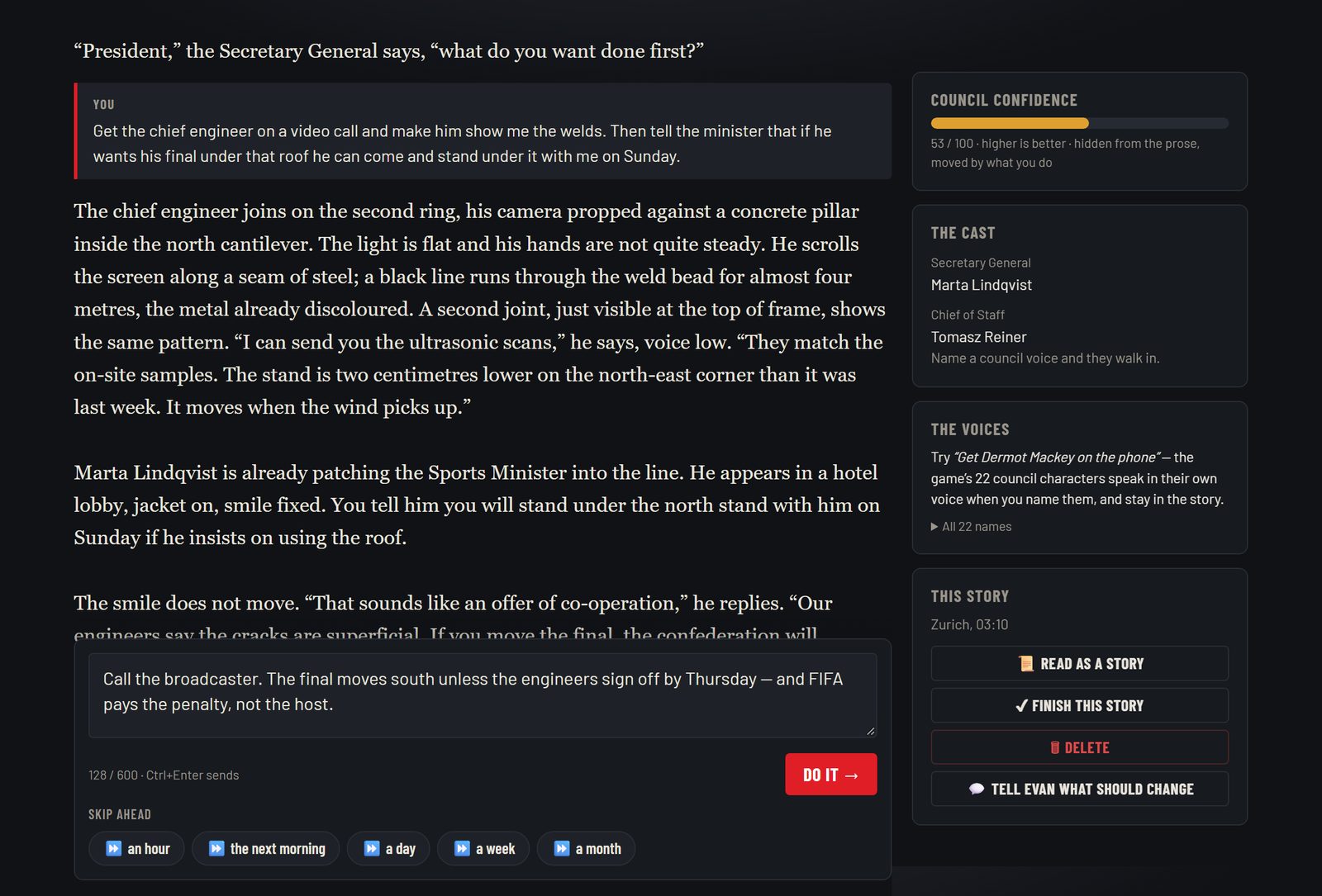
No menus, no dice. Ring the engineer. Dock them ten points. Tell the minister to stand under the roof with you. Or skip ahead an hour, a morning, a week — and see what festered.
Two hundred words of consequence in about ten seconds: who rang, who leaked, what the sponsor emailed, what the fans unfurled. It always ends on an open situation. Your move again.
Six days to the World Cup final and the engineers say the north stand moves in the wind. The host minister says it's fine. The broadcaster wants a venue by nine. 1.9 billion people are watching on Sunday.
“The stand is two centimetres lower on the north-east corner than it was last week. It moves when the wind picks up.”

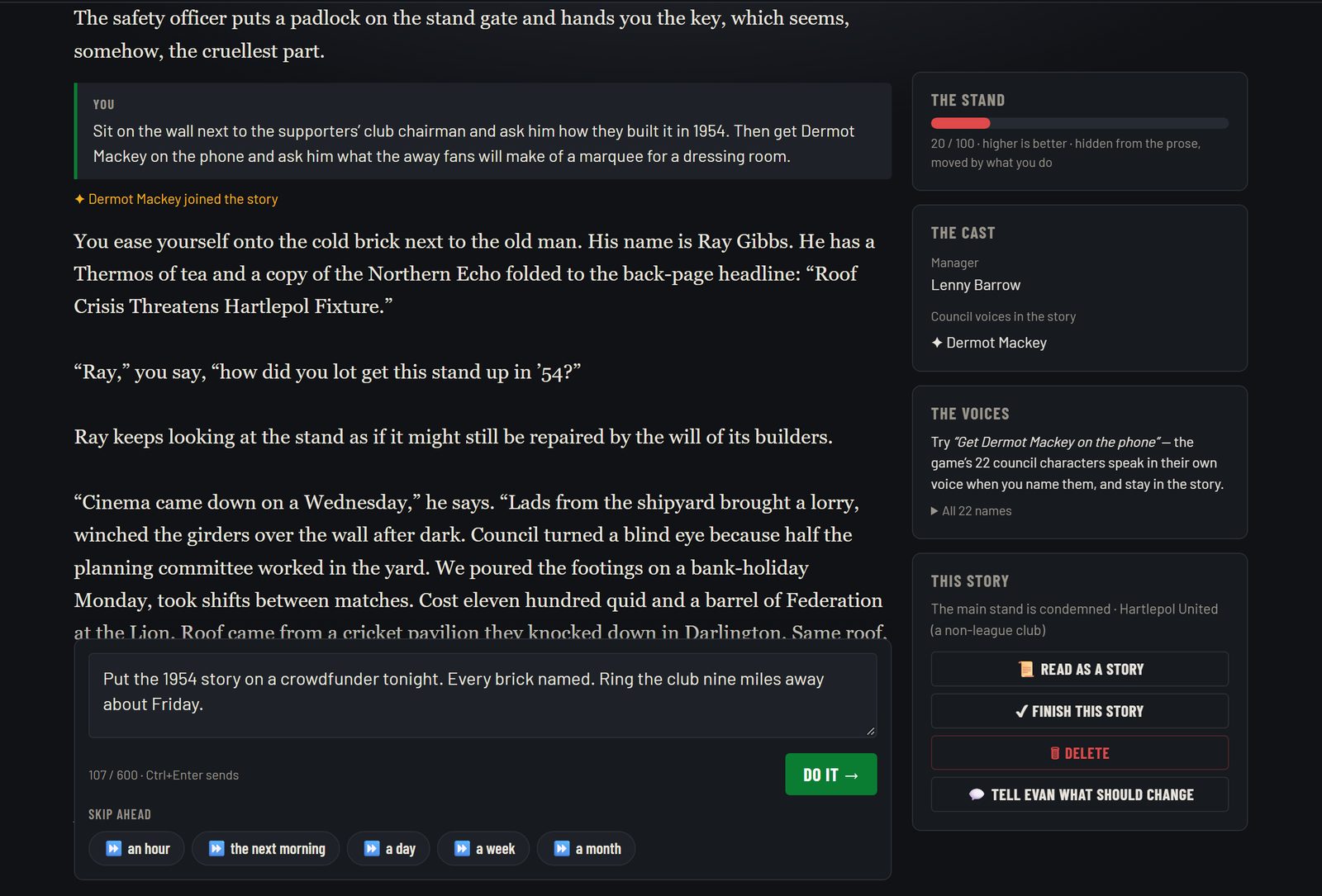
Pick any of 494 clubs across England, Scotland, Germany, Spain and Italy. The stories are written to the club's size: nine-figure transfers at the top, a padlock on the 1954 main stand at the bottom, and fifteen marquee clubs with stories written just for them.
“Cost eleven hundred quid and a barrel of Federation at the Lion. Roof came from a cricket pavilion they knocked down in Darlington.”

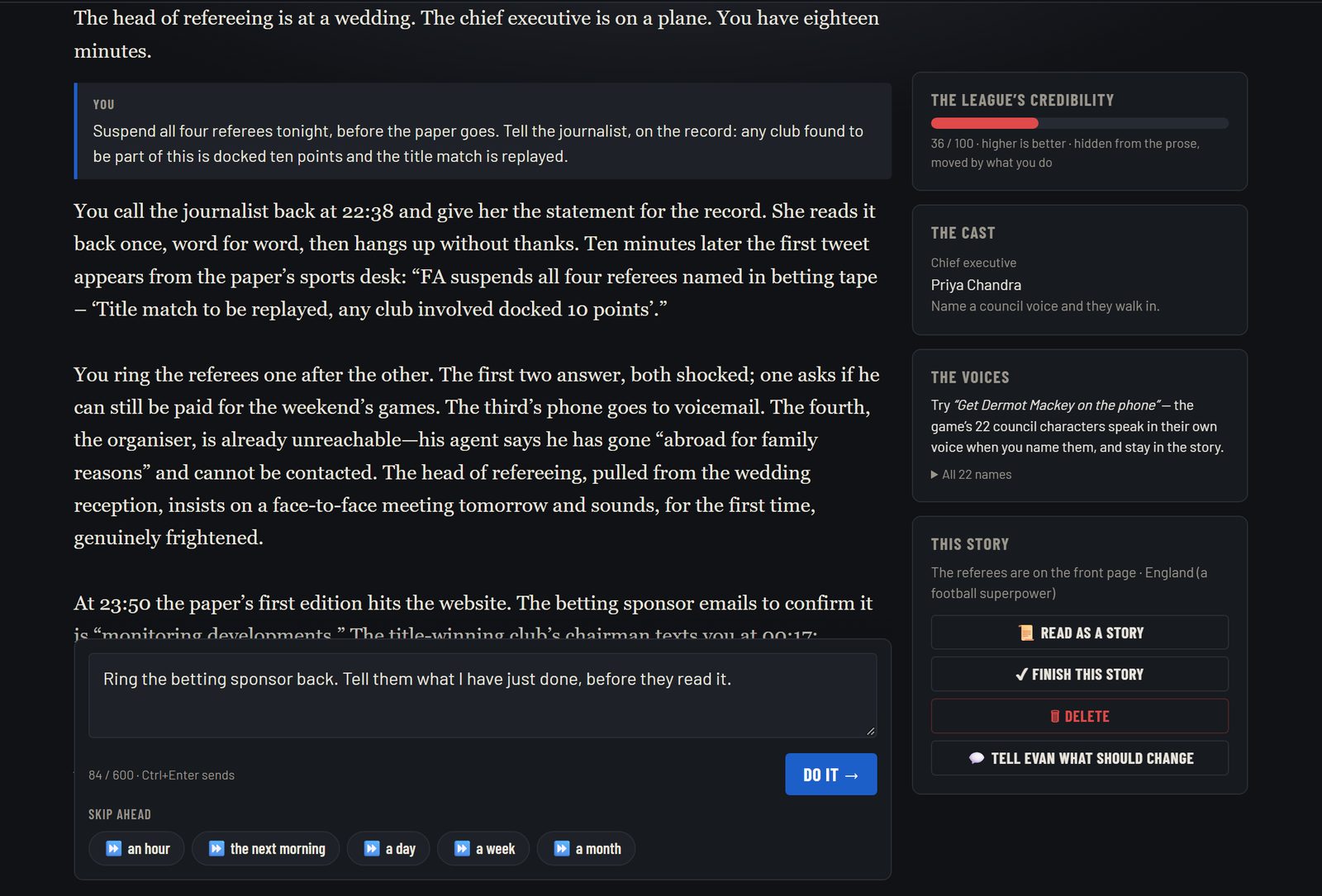
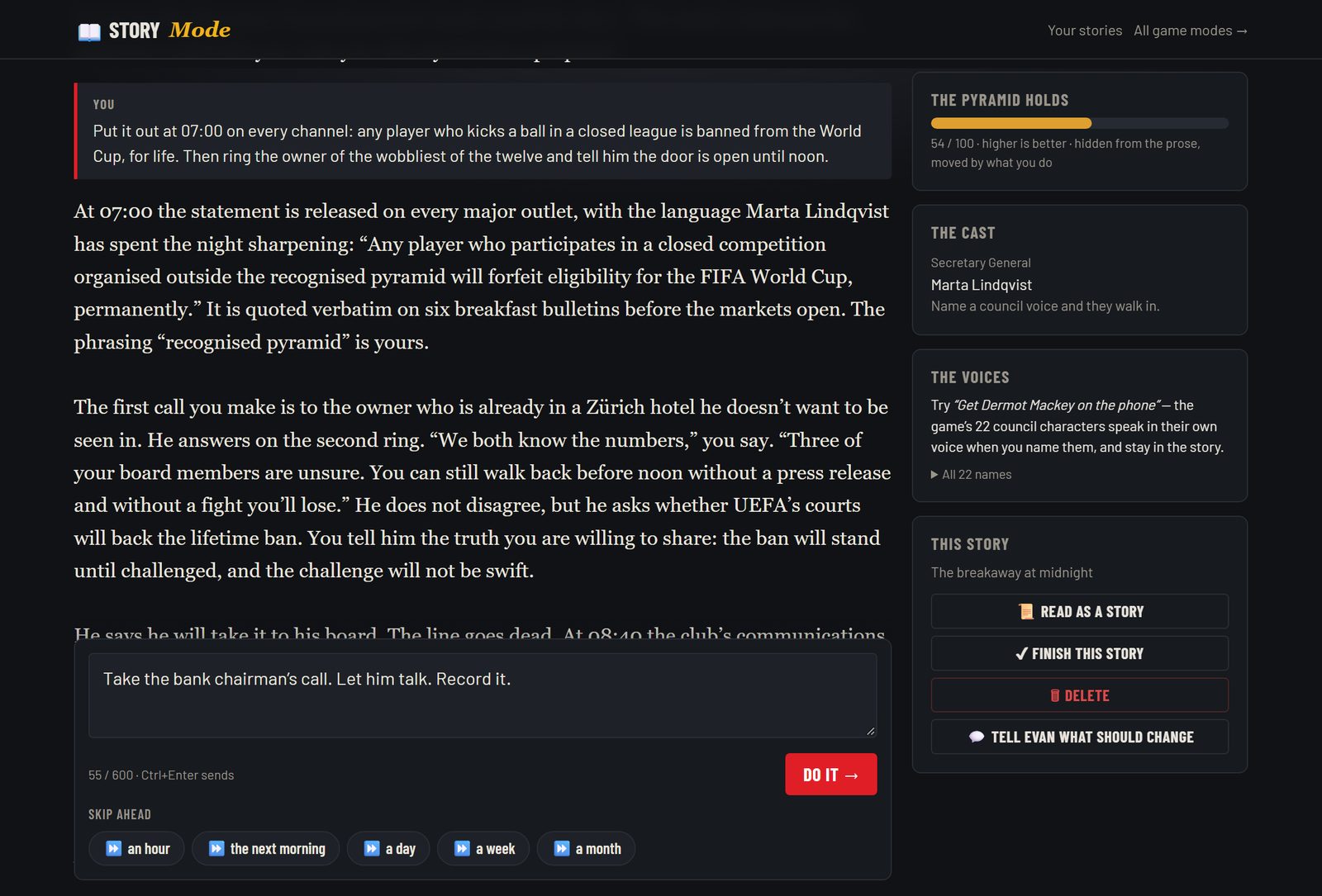
Three referees on tape and eighteen minutes to answer a journalist. Twelve clubs announcing a breakaway at midnight. The decisions every fan has wanted to make are yours — and every one has a morning after. A hidden gauge moves with every line you type.
“Replay our title? You'll hear from our lawyers by breakfast.”

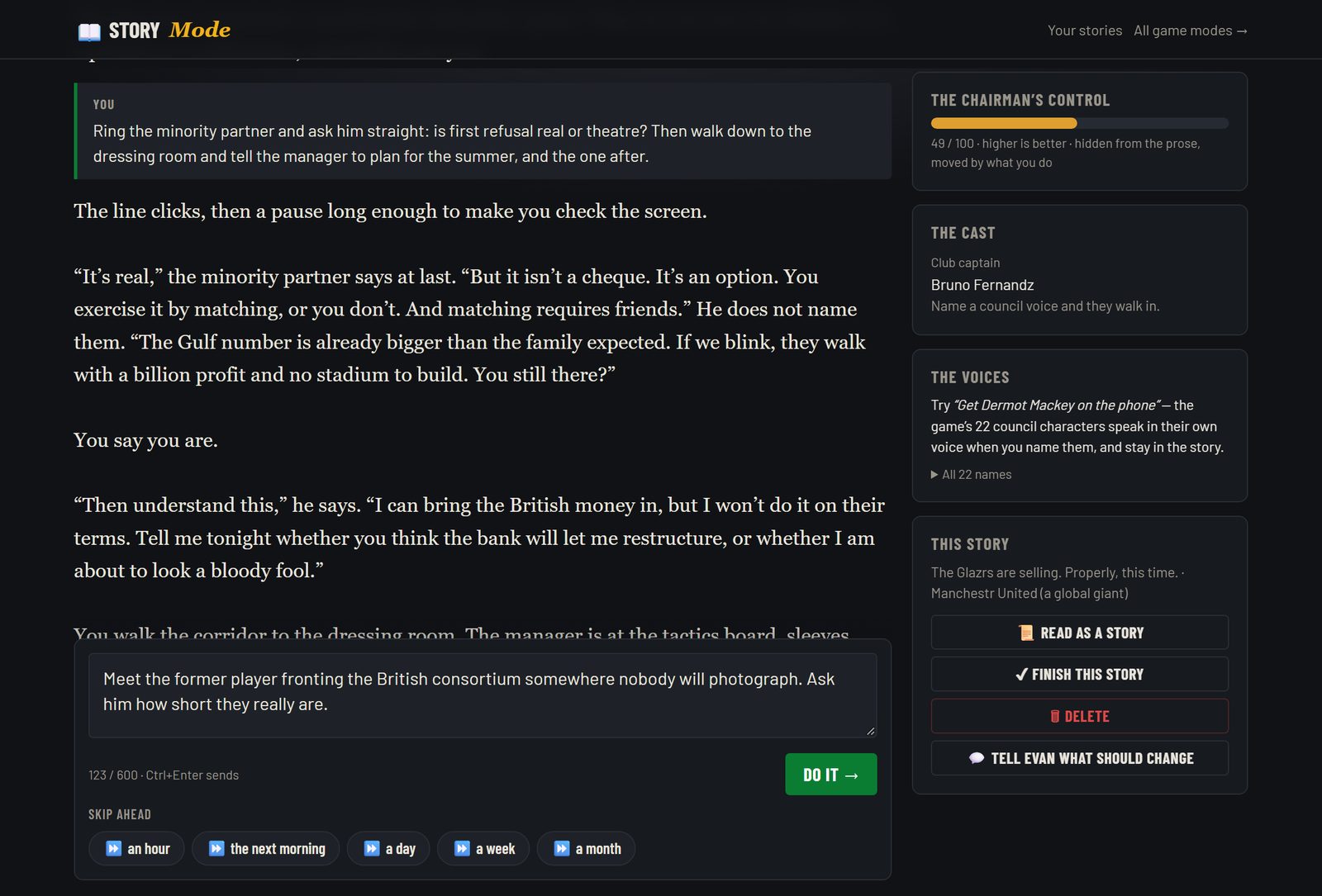
A Gulf state, an American sports group and a British consortium a billion short. A manager six games unbeaten asking whether to plan for the summer. You have the phone. Liverpol, Arsenl, Rael Madrid, Bayrn, Juventis — one letter off, all yours.
“Tell me tonight whether you think the bank will let me restructure, or whether I am about to look a bloody fool.”

Type “get Dermot Mackey on the phone” and the warehouse team leader with a spreadsheet of fixture clashes joins the story and stays in it. A Qatari chairman, a YouTuber, a Belgian winger, an investigative reporter — the game's council characters speak for themselves, and they can be rude about you.
“Hartlepol in a tent is a novelty for one week. Then it's a relegation scrap on a building site.”

Eight scenarios for the FIFA chair, thirty-five for clubs and twenty-four for federations — plus a sandbox for each, where nothing is wrong until you make it so.
Premium members can also write their own: a title, an opening passage word for word, and private notes the narrator keeps to itself.
If it plays in the top five tiers of England, the top four of Scotland, Germany or Italy, or the top three of Spain — yes, 494 first teams. The club's own ground, city, history and rivals are the narrator's to use; the name is spelled a letter off, as it is across Football President.
An AI narrator (Grok), briefed with the scenario's private director's notes, your club's real scale and the game's council characters. It writes in second person, present tense, British English, 120 to 280 words a turn, and it is not allowed to make your decisions for you.
Anything up to 600 characters. Short works as well as long — “Sulk”, “Attend”, “Sack him” all get a world's worth of answer. If an action is impossible or absurd, the world reacts to the attempt. Real public figures of football can appear doing their public jobs; the narrator will not invent crimes or private lives for them.
No. Story Mode is fiction for adults who like football drama: it can be dark, cynical, funny or strange. You tick an 18+ acknowledgement before your first story.
Pick the chair. Pick the crisis. Type what you'd actually do.
Open a story →